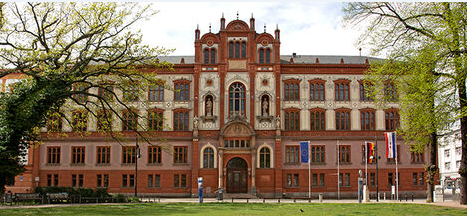

The University of Rostock offers a diverse, varied and challenging position in a tradition-conscious, yet innovative, modern and family-friendly university in a lively city by the sea.
At the Faculty of Computer Science and Electrical Engineering / Institute of Visual and Analytic Computing, subject to budgetary provisions, we are filling the following position at the earliest possible date on a temporary basis for a period of three years:
Research Assistant (m/f/d) - Machine Learning for Earth Observation

at the earliest possible date

full-time with 40 hours


W 124/2026
Please do not hesitate to contact us for further information:
Pia-Lucy Dahl
Phone number: 0381/498-1291
E-mail: pia.dahl@uni-rostock.de
Jun.-Prof. Dr. rer. nat. Stefan Oehmcke
E-mail: stefan.oehmcke@uni-rostock.de
The Visual and Analytic Computing in Ocean Technologies (VACOT) group invites applications for a research position developing machine-learning methods for Earth observation data. The position provides an opportunity to pursue a doctorate (Dr.-Ing.) at the University of Rostock and will be shaped in close scientific collaboration with Ankit Kariryaa at the University of Copenhagen.
Machine learning research
How can models learn from observations with different resolutions, irregular acquisition times, and missing data when the underlying systems interact? This PhD investigates that question through heatwaves on land and in coastal waters and their relationships with the atmosphere. The PhD will focus on methodological research in machine learning, using Earth observation and heatwave modelling as a challenging application domain for developing and evaluating new methods. The specific research question and methodological approach will be developed together with the PhD researcher.
Potential subprojects include:
- Multimodal and multiscale representation learning from satellite imagery, environmental time series, and point sensor measurements
- Geometric deep learning to model spatial relationships and temporal interactions between land, sea, and atmosphere
- Transfer learning and probabilistic modeling for new coastal regions, changing data availability, and extreme events
Copenhagen collaboration and application partners
A central component is collaboration with Ankit Kariryaa at the Department of Geosciences and Natural Resource Management (IGN) and the department of Computer Science (DIKU), University of Copenhagen. Potential application partners include the Leibniz Institute for Baltic Sea Research Warnemünde (IOW) and relevant coastal, climate, and ecology groups at IGN and the University of Rostock. Their involvement will be discussed according to the research question; they can contribute domain expertise for interpreting data and evaluating models.
THESE ARE YOUR TASKS:
- independently conducting a machine learning research project under academic supervision with the goal of earning a Ph.D.
- developing software prototypes and reproducible experiments; comparing and evaluating models across independent regions and events
- authoring and presenting scientific publications, with the aim of publishing research results at leading international conferences in machine learning and computer vision
- documenting and making research code available within the scope of available rights
- collaborating with academic partners and exchanging ideas on methodological and application-oriented research questions
- contributing to teaching (e.g., in seminars) and supervising student projects within the scope of one’s own subject-matter expertise
- developing and writing a dissertation
THIS MAKES YOU A GOOD FIT:
- completed academic degree (Master’s, Diplom, or equivalent) in computer science, mathematics, physics, electrical engineering, geoinformatics, or a related field, with at least a “good” grade
- solid foundation in machine learning and strong programming skills, preferably in Python; practical experience with a common deep learning framework
- Interest in methodological ML research and in collaborating with researchers from other disciplines
- very good written and spoken English skills for scientific publications and international exchange
- the following are desirable:
- prior knowledge of remote sensing or experience from relevant courses, research projects, or practical projects
- experience with geodata, graph learning, probabilistic modeling, or environmental applications
- knowledge of the German language or a willingness to learn it
- publication experience
- willingness to work seriously and with dedication on a project aimed at advancing one's own academic qualifications
WE AS AN EMPLOYER:
Equal opportunities are important to us. We welcome applications from suitable severely disabled people or people from traditionally underrepresented groups. We aim to increase the proportion of women in research and teaching and therefore encourage suitably qualified women to apply. We welcome applications from people of other nationalities or with a migration background.
WE OFFER YOU:
FURTHER INFORMATION:
We will determine the experience level individually, taking into account your previous professional experience.
If you would like to work part-time in this position, this is possible subject to the requirements of the position.
The temporal limitation of the employment relationship is based on § 2 (1) Wissenschaftszeitvertragsgesetz.
We look forward to receiving your application by 15.10.2026 at the latest. Please send us:
- motivation letter (maximum one page) addressing the ML focus of the position
- CV including education, relevant experience, and language skills
- degree certificates and transcripts, with a translation for documents in languages other than German or English. If your degree is pending, initially provide a current transcript and your expected completion date
- optional: a publication list or examples of your own research, coursework, or software projects
We can only consider applications received via our homepage. Please send us your documents via the ‘Online application’ button at the end of a job offer. Unfortunately, we cannot accept e-mail applications.
Incomplete application documents may not be considered in the further course of the selection process.
Unfortunately, we can not cover application and travel costs.
Become part of the team
VACOT at the University of Rostock's Institute for Visual and Analytic Computing is led by Jun.-Prof. Dr. Stefan Oehmcke. Under the Earth & Ocean ML research profile, the group develops methods for spatiotemporal and multimodal data in environmental and maritime applications. Research topics include representation learning, self-supervised learning, and efficient inference. Stefan Oehmcke's additional appointment at the University of Copenhagen's Department of Computer Science provides an existing connection between the two locations.
Research profile: https://stefoe.github.io/
We look forward to receiving your application!
Contact
Universität Rostock
18051 Rostock
Tel.: +49 381 498 - 0
Sitze des Rektorats:
Universitätsplatz 1
18055 Rostock
Certificates
Familienfreundliche Hochschule HRK-Audit
 Facebook
 You Tube
 Instagram