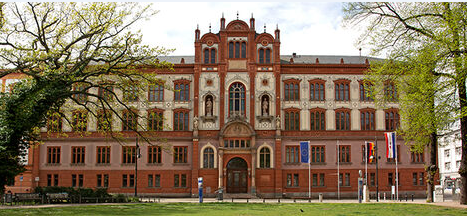
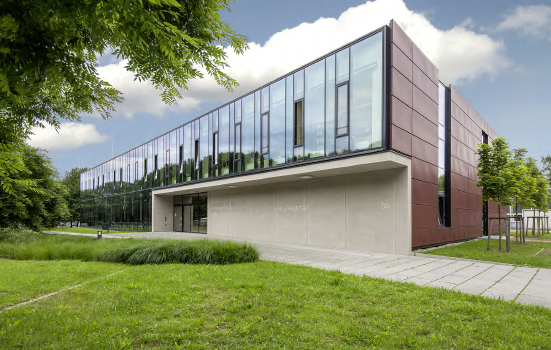



The University of Rostock offers a diverse, varied and challenging position in a tradition-conscious, yet innovative, modern and family-friendly university in a lively city by the sea.
At the Faculty of Mathematics and Natural Sciences, Institute of Physics, Working Group of Theoretical Light-Matter Interaction, subject to allocation of funds, we are filling the following position at the earliest possible date on a temporary basis for the duration of the project "SFB LiMatI" ending on 31.12.2029:
Research Assistant (m/f/d) - Theoretical Physics

at the earliest possible date

part-time with 30 hours


P 84/2026
Please do not hesitate to contact us for further information:
Lisa Malke
Phone number: 0381/498-1281
E-mail: lisa.malke@uni-rostock.de
Jun.-Prof. Dr. Maria Richter
Phone number: 0381/498-6765
E-mail: maria.richter@uni-rostock.de
The Research Group "Ultrafast Light-Matter Interactions" led by Jun.-Prof. Maria Richter at the Institute of Physics, University of Rostock, invites applications from a doctoral candidate (m/f/d) for the development and application of theoretical methods to investigate the macroscopic propagation of complex light fields in gases and condensed matter.
The emerging field of research of the generation of complex light structures with three-dimensionally structured light fields in space and time—such as so-called synthetic chiral light—offers entirely new degrees of freedom for the ultrafast optical investigation and manipulation of atomic and molecular structures and dynamics. A prime example of this is the study of electronic currents in chiral molecules, in which the interactions between light and molecules are not based on the weak interaction with the magnetic component of light - as has been the convention so far - but rather on electric-dipolar interactions with the synthetic chiral light. This enables an extremely efficient, ultrafast, and fully optical enantioselective investigation of chiral matter. Previous studies have largely been limited to describing such light-matter interactions at the microscopic level. We plan to investigate and optimize light-controlled ultrafast processes at the macroscopic level as well.
We recently developed a state-of-the-art model for simulating the spatiotemporal, nonlinear dynamics of intense, ultrashort laser pulses in atomic gases based on the unidirectional pulse propagation equation (UPPE). The candidate will contribute to the research topic by adapting and extending our pulse propagation method to calculate and analyze the nonlinear optical response of, for example, chiral matter on a macroscopic scale.
The successful candidate will gain extensive knowledge and experience in the fields of theoretical and computational nonlinear optics, atomic, molecular, strong-field, and attosecond physics; have access to state-of-the-art high-performance computing facilities; collaborate with experienced scientists, doctoral students, and undergraduates; and experience a positive and supportive group atmosphere.
THESE ARE YOUR TASKS:
- conducting research in the fields of nonlinear optics and light-matter interactions, particularly the interaction of complex light structures with molecular gas and condensed matter at the microscopic and macroscopic levels, with the goal of earning a doctoral degree
- application of state-of-the-art methods in nonlinear optics, strong-field and attosecond physics, and quantum chemistry to develop new theoretical models for describing the macroscopic propagation of spatially and temporally structured laser fields in complex materials
- development and implementation of numerical models, execution and evaluation of numerical simulations, and analytical modeling
- active collaboration with national and international interdisciplinary research groups
- publishing research findings and presenting them at academic conferences and workshops
- academic, research-based teaching totalling as part of the project 2 SWS (seminars, labs, exercises) in the field of physics, with the goal of enabling students to conduct independent scientific work
- designing, preparing, grading, and correcting students' academic assignments
- assisting with tasks related to academic management and administration
THIS MAKES YOU A GOOD FIT:
- a completed academic degree (Diplom, Master’s, or equivalent) in Physics, Photonics, and/or optical sciences, preferably with very good grades
- very good knowledge and some initial experience in the fields of theoretical nonlinear optics as well as mathematical and numerical physics
- experience in simulating nonlinear light propagation and/or light-matter interactions is desirable
- strong interest in the development of theoretical or computer-based methods in nonlinear optics
- passion for programming and a strong command of at least one of the following programming languages: Python, C++, Fortran
- proficiency in spoken and written English skills as well as basic knowledge of German or willingness to acquire it quickly
- strong communication skills for presenting research findings
- willingness to work seriously and with dedication on a project aimed at advancing your own academic qualifications (doctoral degree)
- ability to collaborate positively and constructively with a diverse group of people of different backgrounds, nationalities, ethnicities, genders, etc.
- ability to work independently, with focus and a goal-oriented approach, as well as to work as part of a team
WE AS AN EMPLOYER:
Equal opportunities are important to us. We welcome applications from suitable severely disabled people or people from traditionally underrepresented groups. We aim to increase the proportion of women in research and teaching and therefore encourage suitably qualified women to apply. We welcome applications from people of other nationalities or with a migration background.
WE OFFER YOU:
FURTHER INFORMATION:
We will determine the experience level individually, taking into account your previous professional experience.
The temporal limitation of the employment relationship is based on § 2 (1) Wissenschaftszeitvertragsgesetz.
We look forward to receiving your application (cover letter, CV, degree certificate stating your final grade) by 31.08.2026 at the latest. We can only consider applications received via our homepage. Please send us your documents via the ‘Online application’ button at the end of a job offer. Unfortunately, we cannot accept e-mail applications.
Incomplete application documents may not be considered in the further course of the selection process.
Unfortunately, we can not cover application and travel costs.
Become part of the team
We look forward to receiving your application!
Contact
Universität Rostock
18051 Rostock
Tel.: +49 381 498 - 0
Sitze des Rektorats:
Universitätsplatz 1
18055 Rostock
Certificates
Familienfreundliche Hochschule HRK-Audit
 Facebook
 You Tube
 Instagram